How to Get Startup Funding: Essential Guide for 2026
August 24, 2026 · 12 min read
In 2025, global venture funding hit about $368 billion, while early-stage funding reached $37 billion. That gap is the starting point for anyone trying to learn how to get startup funding, because it shows that the money is still there, but most of it is concentrated later in the journey, where investors can write bigger checks and spread risk across fewer deals. Early-stage founders are not competing in a wide-open market. They're competing in a narrower pool, with more selective capital and a shorter window to prove they belong in it.
That changes the game in two ways. First, the best founders don't treat fundraising like a single pitch event. They treat it like a staged process that starts long before cash runs low and continues through qualification, timing, and follow-up. Second, they stop assuming every dollar is equal. A grant, a cloud credit, an accelerator stipend, and a seed check all solve different problems, and the wrong sequence can weaken your negotiating position instead of extending it.
Table of Contents
- Current State of Early-Stage Funding
- Preparing Your Startup Before You Ask for Money
- Comparing Every Funding Route Available to Early-Stage Founders
- Understanding Fundraising Conversion Rates and Investor Bias
- Stacking Non-Dilutive Capital to Extend Your Runway
- Building a Realistic Fundraising Timeline and Action Plan
Current State of Early-Stage Funding
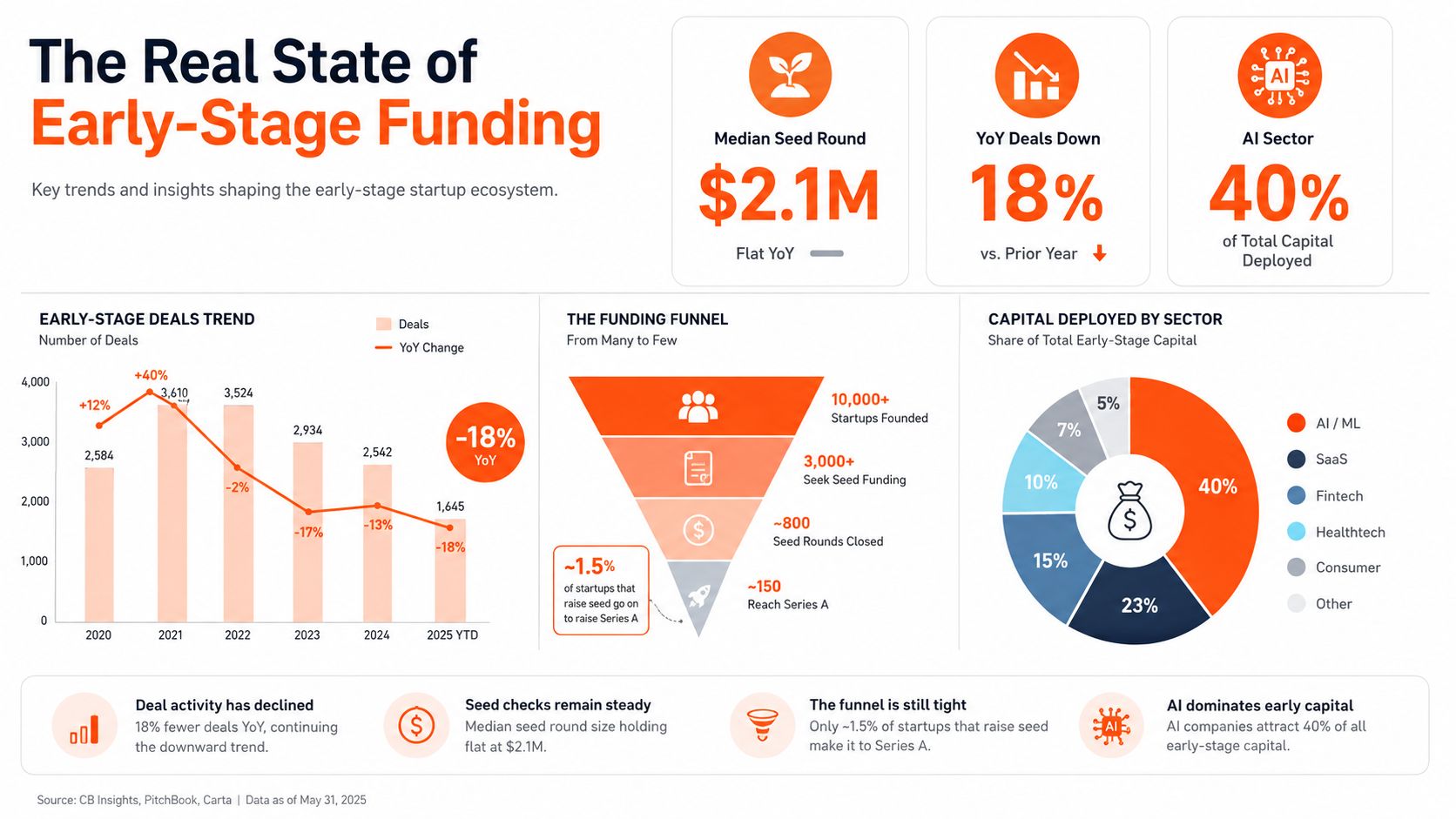
The headline numbers in venture capital can mislead founders. In 2025, total global venture funding reached about $368 billion, while early-stage funding was $37 billion Crunchbase. That gap matters because early-stage capital is still concentrated in a narrower slice of the market, where investors want stronger proof before they write.
The more useful read is the timing. Early-stage capital rose 20% quarter over quarter and 36% year over year, which sounds healthy, but founders still face a market where each round is harder to reach than the last. In practice, category fit, timing, and traction usually matter more than broad fundraising advice admits.
Why timing now matters more than hype
The gap between rounds has also widened. Median time between funding rounds stretched from about 451 days in 2021 to 744 days in Q4 2024, nearly 65% longer, so founders need more runway before they start the next raise Credit for Startups. If you begin outreach too late, strong storytelling usually will not save the terms. It just leaves you with less room to negotiate.
Practical rule: raise while you still have options, not when cash pressure is setting the agenda.
That is why early-stage fundraising moves in cycles. Some windows reward speed and a clear narrative, others reward restraint, revenue quality, and technical differentiation. In crowded categories like AI, investors are often deciding fast, with a bias toward specific signals and away from long explanations.
Non-dilutive capital can change that timing. A grant, cloud credit, or accelerator stipend does not replace equity, but it can stretch runway enough to close the gap between rounds and improve the next conversation. The StartupFlow AI credits report is a useful place to check how credits fit into that stack before you choose your first source of capital.
Preparing Your Startup Before You Ask for Money
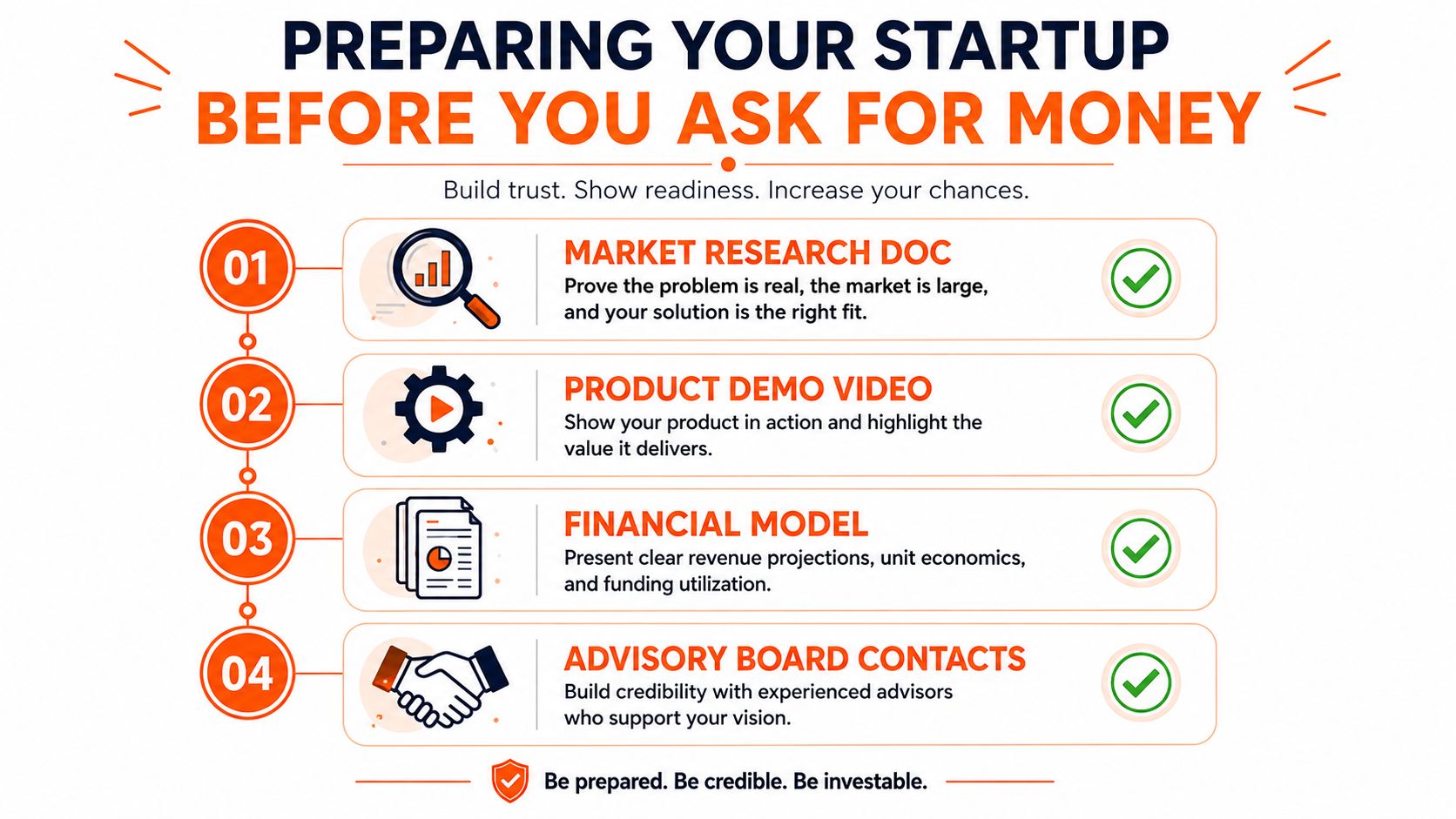
The fastest way to waste fundraising cycles is to start outreach before your materials can survive scrutiny. Investors don't just ask for a deck. They ask for evidence that the company is real, the market is worth the trouble, and the founder understands the operating reality. That's why the strongest pre-seed and seed packages look less like marketing and more like a compact diligence file.
Build the evidence before the story
A credible package usually starts with a few core artifacts. You need a clean market research note, a product demo that shows the thing working, a financial model that makes your assumptions visible, and a set of warm contacts who can vouch for execution. If any one of those is missing, founders often end up improvising in investor meetings, which is where confidence leaks away.
Use this as a practical checklist before outreach begins:
- Market clarity: Write down the problem, the buyer, and the reason now is the right time.
- Product proof: Keep a demo that shows the workflow without narration gymnastics.
- Runway math: Know exactly how much time you have before the next financing decision.
- Reference support: Line up advisors, operators, or early customers who can verify your credibility.
The point isn't to overbuild. It's to remove friction so the first meeting isn't spent answering questions you could've answered upfront.
Match the package to the stage
Early-stage investors care less about polished branding than about signal density. At seed, investors still want traction, but they'll read traction differently depending on the business. For software, that can mean active use, retained users, or revenue quality. For deep tech, it may be technical differentiation and a believable path to adoption.
Strong fundraising starts with a company that can explain itself without hand-holding.
The other half of preparation is deciding who you're raising from. Accelerator applicants, angel targets, and institutional seed funds all look for different evidence, and a one-size-fits-all packet usually disappoints all three. If you're comparing structured programs, the startup accelerator guide is a useful way to sort by fit instead of enthusiasm.
Comparing Every Funding Route Available to Early-Stage Founders
Founders waste time when they treat every capital source as if it does the same job. It doesn't. Bootstrapping buys control. Grants and credits buy runway. Accelerators buy access, feedback, and sometimes a small check. Angels buy early conviction. Venture capital buys scale, along with more pressure and less room for error.
Funding Routes Compared
| Route | Typical Amount | Equity Cost | Timeline | Best For |
|---|---|---|---|---|
| Bootstrapping | Varies by revenue and savings | None | Immediate, if you already have cash flow | Founders who can sell early or keep burn low |
| Grants | Varies by program | None | Slower and application-heavy | Deep tech, public-interest work, and eligible sector-specific startups |
| Cloud and AI credits | In-kind support | None | Fast once approved | AI and software teams with meaningful infrastructure spend |
| Accelerators | Small cash plus program support | Usually yes | Program-based and cohort-driven | Founders who need structure, introductions, and investor access |
| Angel investors | Early check sizes vary | Yes | Can move quickly with warm intros | Companies with a clear story and a founder-led sales motion |
| Venture capital | Larger checks | Yes | Longer, more selective | Startups with strong upside and evidence of scalable demand |
Bootstrapping is underrated because it forces discipline. If you can reach real usage or revenue without outside money, you walk into fundraising with more bargaining power instead of a plea. That matters even more when the gap between rounds is shorter than founders expect.
Grants and credits fill a different role. They do not replace investors, but they can keep you alive long enough to raise from a stronger position. For AI teams, infrastructure spend can become a silent drain, so cloud and model credits belong in the capital stack, not as an afterthought.
Accelerators are useful when you need more than money. They are a shortcut to learning, but they also screen hard. Top programs are highly selective, and many founders enter expecting funding when the program itself is the main asset. If you are comparing cohorts, this side-by-side guide is a practical way to judge the trade-offs between access, structure, and investor attention.
Angel investors and venture capital sit later in the sequence. Angels can move faster and feel more personal. VC is more structured and more demanding. The questions you get also shift by route. Accelerators often reward coachability and speed. Angels tend to back the founder story. Institutional seed funds press harder on scale, repeatability, and whether the market can support a larger outcome.
Understanding Fundraising Conversion Rates and Investor Bias
Fundraising is a funnel, not a verdict on your company. Founders usually see only the visible steps, the intro email, the first meeting, the follow-up call, the term sheet discussion. The process is messier, and a lot of drop-off is normal even when the business is real.
The funnel is harsher than founders expect
The conversion math is often brutal. Top accelerators are widely described as having a very low acceptance rate, and only a slice of participants go on to close investment after the program Mean CEO. The lesson is simple. Getting attention is not the same as getting capital.
Treat fundraising like pipeline management. You need enough qualified prospects to absorb rejection, and each step has to be handled on its own, outreach, meetings, diligence, and close. A strong deck cannot rescue a weak list, and a strong list cannot rescue poor follow-through.
Timing also matters more than founders expect. Investors do not evaluate you in a vacuum, they compare you against other opportunities in flight, and they often form a view early. If you start too late, you end up asking from a weak position, with little room to let conversations breathe.
Question framing changes outcomes
Investor bias is uncomfortable to discuss, but ignoring it does not help. Research summarized by the Harvard Gender Action Portal says investors ask men more about promoting success and women more about avoiding failure, which changes both the questions founders hear and the confidence the room rewards. Academic work based on TechCrunch Disrupt Q&A sessions found that promotion-focused questions were linked to significantly higher funding, while each additional prevention-focused question hurt fundraising outcomes Harvard Gender Action Portal.
That does not mean founders should fake their way through investor meetings. It means you should prepare for the shape of the conversation, not just the substance. If diligence turns prevention-heavy, answer the risk before the room gets stuck there.
Prepare two versions of your story, one that emphasizes upside, one that handles risk without sounding defensive.
Access still shapes outcomes. Seed-stage founders often run into the same problem, they do not just need capital, they need a path into the right rooms. Introductions, category familiarity, and whether the market already feels crowded all affect how far a conversation goes.
The question investors ask first matters too. Some leads open with growth potential, others start by stress-testing downside. The founder who recognizes that bias early can steer the discussion instead of reacting to it.
Stacking Non-Dilutive Capital to Extend Your Runway
The cleanest fundraising stories usually start with messy, non-dilutive money. Cloud credits, AI credits, grants, and accelerator stipends will not replace a real raise, but they buy time and lower the pressure to accept the first term sheet that lands in your inbox. That extra runway often changes the quality of investor conversations more than another deck rewrite.
Sequence the low-friction money first
Non-dilutive capital works best as a sequence, not a scavenger hunt. If your startup qualifies for infrastructure credits, apply early and track usage closely, because credits only matter when they offset spend. Stack them with grants or accelerator support, and you can cut burn without giving up equity too soon.
The practical payoff is simple. More runway means less desperation, and less desperation usually means a stronger position in equity talks.
For founders comparing cloud spend relief, the cloud credits guide is a useful place to sort which programs fit before you commit to paying full freight.
Match the capital to the constraint
Each non-dilutive option solves a different problem. Grants fit startups whose work lines up with a provider's mission or program rules. Cloud credits help when infrastructure is the bottleneck. Accelerator stipends are more useful when the gap is introductions, accountability, or early validation. The mistake is piling into programs that sound impressive but do not solve the constraint in front of you.
A simple test helps. If the team is still working out product-market fit, credits and grants can buy room to learn. If the product is already showing pull, accelerator access or founder networks may be the better bridge into institutional capital. If a raise is close, the goal is to arrive with lower burn, more proof, and fewer emergencies.
StartupFlow AI fits that workflow as one place to search across eligible cloud credits, accelerator programs, grants, and investor matches. It helps most when the problem is not finding more options, but narrowing them to the ones you can qualify for.
Building a Realistic Fundraising Timeline and Action Plan
Founders who start fundraising only after cash gets tight usually end up negotiating from weakness. The better move is to begin while the company still has room to choose timing, because the most important work happens before the first investor meeting.
A timeline that reflects real behavior
Runway gaps between rounds are long enough to matter. As noted earlier, the median time between rounds was 744 days in Q4 2024. That means the timeline should start with materials, then warm outreach, then meetings and diligence, while the company still has enough breathing room to say no to bad terms.
The useful milestone is not “launch the raise.” It is knowing which path you are on. If non-dilutive capital can extend runway enough to avoid a rushed equity round, take it first. If the raise is unavoidable, have the deck, introductions, and follow-up system ready before the first call.
Keep the pipeline moving without losing the product
The hardest part is holding two tracks at once. Some founders stop shipping while fundraising. Others keep building and wait too long to start investor conversations, which leaves them forced into whatever terms are available.
A simple operating rhythm solves more than a polished pitch does. Keep a live target list, update status after every conversation, and schedule the next touchpoint before the current one goes cold. Re-engagement matters because many investor responses are timing-driven, not final.
Follow-up should test for real objections, not chase attention. If multiple investors raise the same concern, the issue is usually evidence, market fit, or timing, not the need for one more meeting. A deferred “not now” belongs in the pipeline. It is not a dead end.
For founders trying to estimate how much credit relief could buy before a round, the credit savings calculator helps translate non-dilutive support into runway terms.
A realistic action plan is clear. Extend runway where it is cheapest, start outreach before urgency spikes, and keep enough momentum in product work that the company still has a strong position when interest appears.